South Korean Court Orders Chinese Student to Pay Damages for Destroying Falun Gong Information Booth
(Minghui.org) On October 28, 2026, the Seoul Eastern District Court in South Korea issued a ruling in a civil lawsuit concerning the destruction of a Falun Gong truth-clarification site by a Chinese international student. The court ordered the defendant, surnamed Lu, to pay 500,000 South Korean Won (KRW, approximately 366 USD) plus applicable interest to the plaintiff, Falun Gong practitioner Li Chengxue, and to cover the costs of the litigation.
This civil lawsuit stemmed from an incident in September 2025, in which Lu, a Chinese international student, tore down three banners hung by Li Chengxue and overturned a table at the site. Following the incident, the police initiated a criminal case against Lu. On March 23, 2026, the Seoul Eastern District Court issued a summary criminal order regarding the property damage, and imposed a fine of 700,000 KRW on Lu. Li Chengxue also filed a civil suit for damages, which led to the aforementioned court ruling this October.
Chinese Student Faces Criminal Penalties for Vandalizing Falun Gong Information Site
For over a decade, Falun Gong practitioner Li Chengxue has been conducting activities near Exit 2 of Konkuk University Station in Gwangjin-gu, Seoul, South Korea, to raise awareness about the Chinese Communist Party’s (CCP) persecution of Falun Gong. He has duly applied for permits for these activities, including assemblies and demonstrations, in accordance with the law.
On September 16, 2025 at around 11:30 a.m. while Li Chengxue was temporarily away from the site, the stands holding his display boards were severely damaged. The display boards and banners were torn apart and discarded haphazardly on a road used by vehicles. Following a report, the police analyzed surveillance footage and identified the perpetrator as a Chinese student named Lu, who is enrolled at Sejong University. A criminal case was subsequently opened against him.
The investigation revealed that Lu had torn apart three banners that called for an end to the persecution of Falun Gong and overturned a table. The total value of the three banners was approximately 500,000 KRW. The prosecution later requested that the court handle the case via a summary order. On March 23, 2026, the court issued a criminal summary order against Lu, imposing a fine of 700,000 KRW (Case No.: 2025고약100430; charge: property damage).
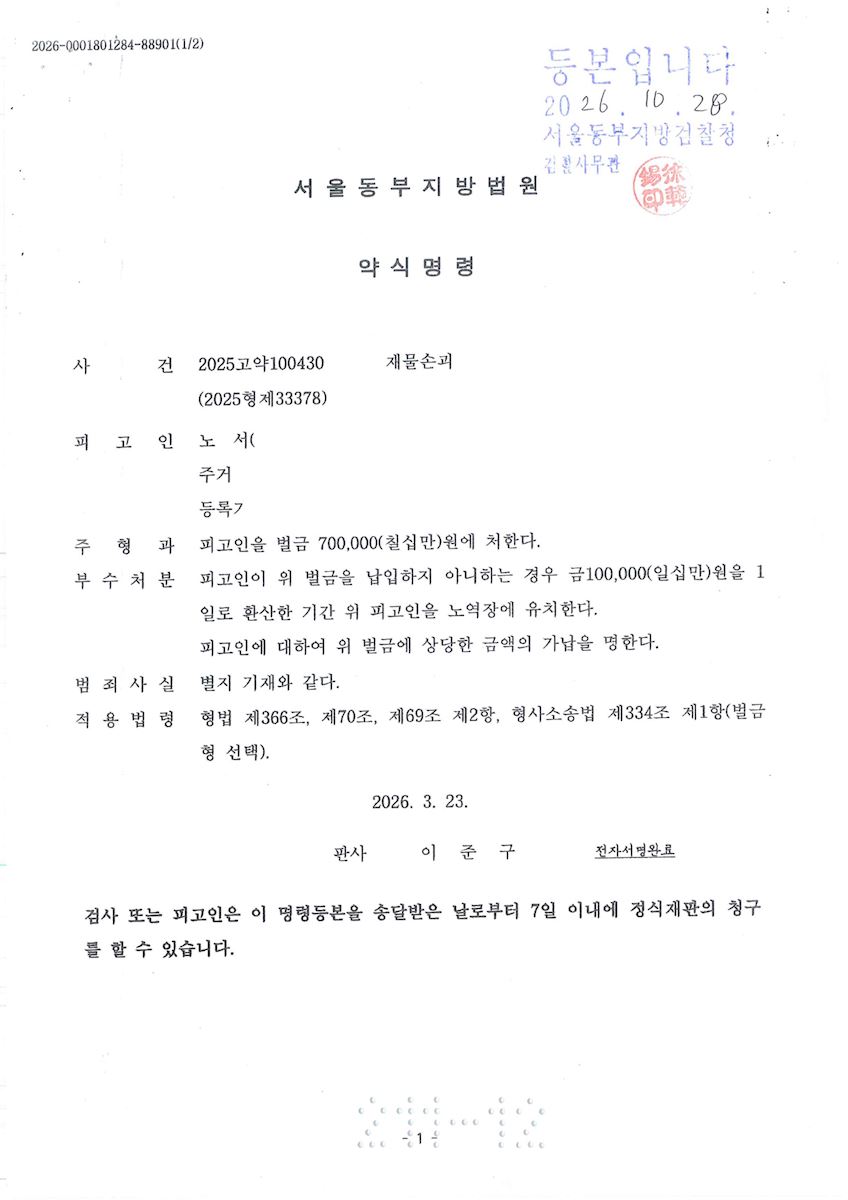
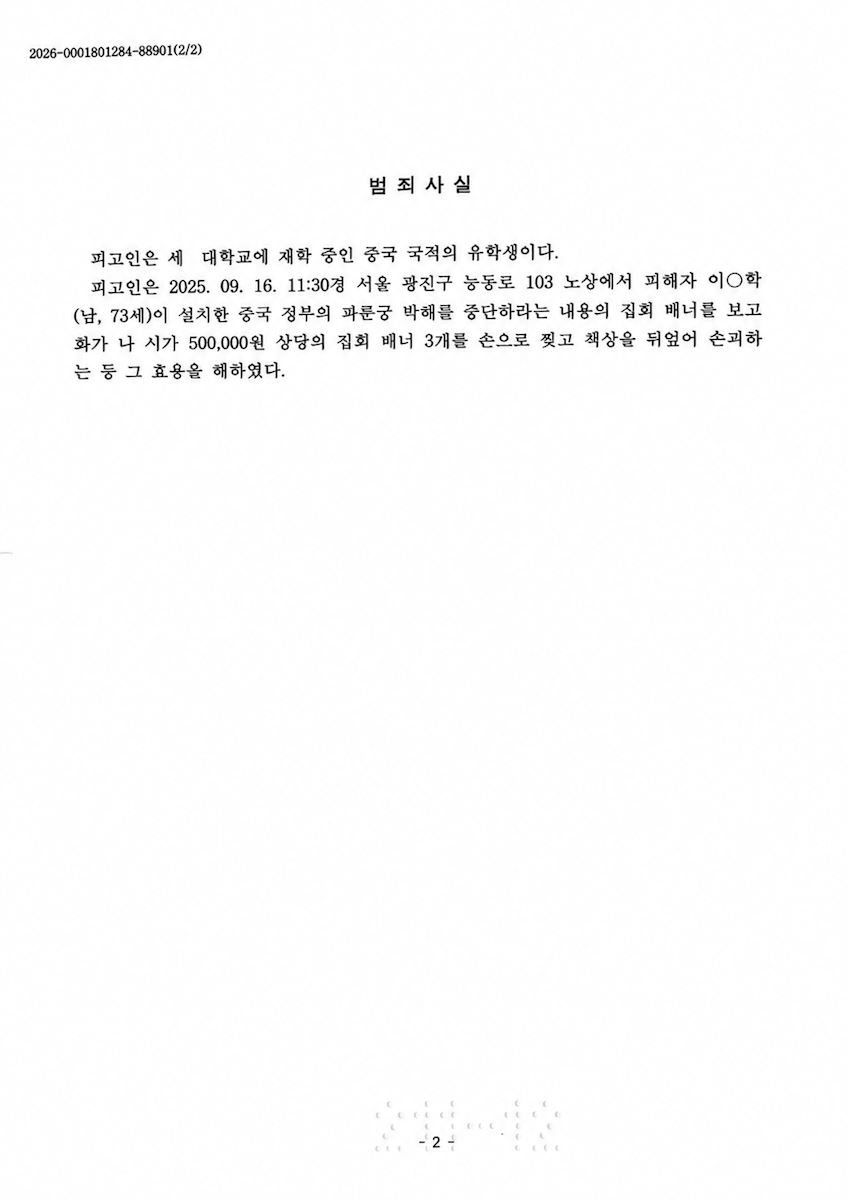
 The Seoul Eastern District Court in South Korea issued a summary criminal order on March 23, 2026, imposing a fine of 700,000 KRW on a Chinese student Lu for damaging a Falun Gong truth-clarification site. (Personal information in the image has been redacted.) (Minghui.org)
As neither the prosecutor nor the defendant raised any objections, the decision on the criminal penalty has taken legal effect.
Upholding Civil Lawsuit Court Orders 500,000 KRW in Damages
To safeguard his legal rights and prevent similar incidents from recurring through legal channels, Li Chengxue filed a civil lawsuit for damages against Lu, seeking 500,000 KRW (Case No.: 2025가소63270, Claim for Damages). During the proceedings, the court proposed a settlement. However, Li Chengxue—wishing to have the facts of the case and the associated legal liabilities clarified through a formal judgment—objected to the proposal and requested that the court issue a ruling in accordance with the law.
Ultimately, on October 28, the Seoul Eastern District Court ruled in favor of the plaintiff, Falun Gong practitioner Li Chengxue. The court ordered the defendant to pay the plaintiff 500,000 KRW, along with interest calculated as follows: an annual interest rate of 5% from September 16, 2025, to March 16, 2026, and an annual interest rate of 12% from March 17, 2026, until the full amount is paid. The legal costs are also to be borne by the defendant.
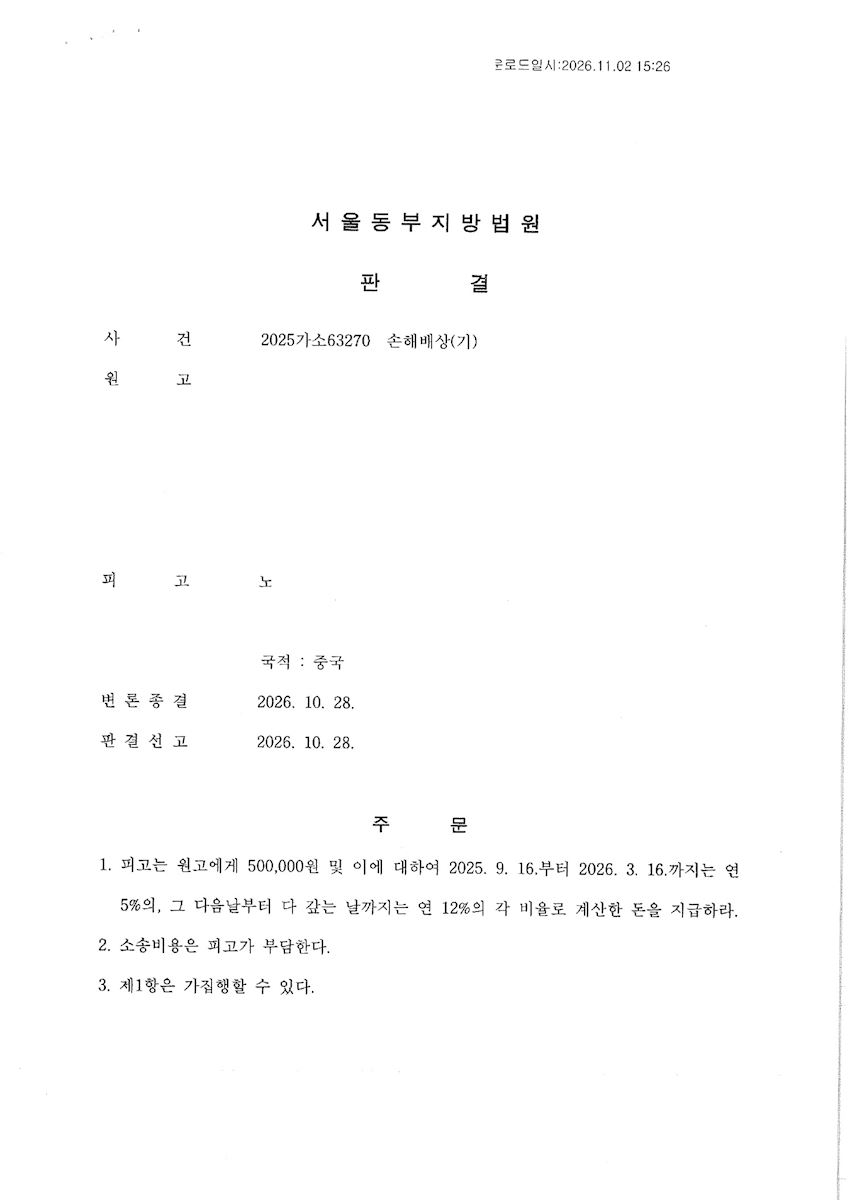
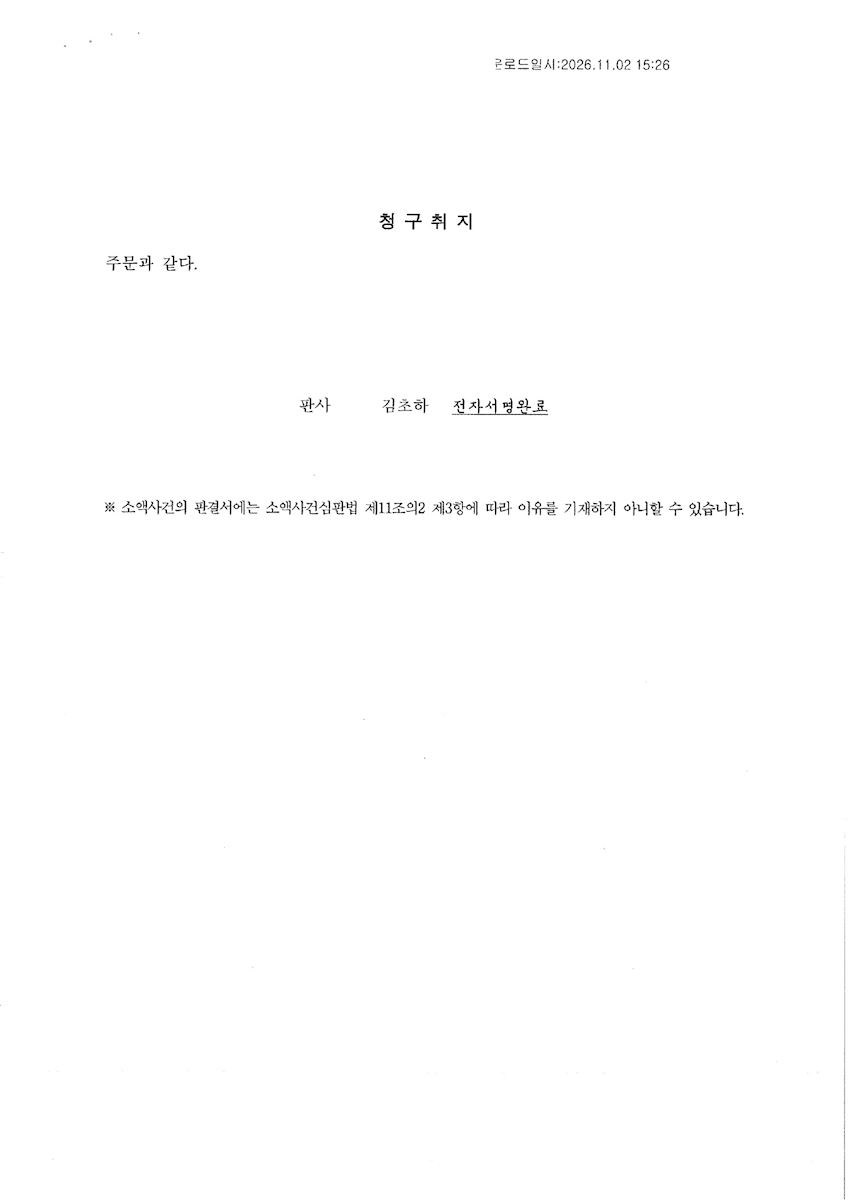
 In a civil judgment issued on October 28, 2026, the Seoul Eastern District Court in South Korea ordered Lu to pay 500,000 KRW plus applicable interest to Falun Gong practitioner Li Chengxue and to bear the costs of the litigation. (Personal information in the image has been redacted.) (Minghui.org)
Li Chengxue explained why he filed the lawsuit, “For a long time in South Korea, Falun Gong information booths have frequently been targeted and vandalized by people such as Chinese students and tourists. Often, these incidents have gone unresolved because the perpetrators could not be identified. Although the financial losses were minor, I initiated this legal action to send a clear message: actions driven by the CCP’s deceptive propaganda that disregard the legal order of a host country and involve attacks on these information booths cannot be tolerated. I am determined to see this civil lawsuit through to the end, both to prevent similar offenses in the future and to serve as a symbolic warning.”
Several days before the court hearing, defendant Lu submitted written materials to the court, along with an explanation for his inability to appear in person. In his statement, Lu wrote: “I acknowledge that I acted rashly and inappropriately while in an emotionally agitated state, and I deeply regret my actions. I have no intention of evading responsibility for the property damage I caused, and I have taken extra care to ensure that such an incident does not happen again.” Regarding the plaintiff’s assertion that his actions were linked to a specific country, political force, or organization, Lu disagreed, emphasizing that the incident was an isolated, spontaneous act.
South Korea Falun Dafa Association Welcomes Court Ruling
Wu Shilie, Secretary-General of the South Korea Falun Dafa Association, commented on the verdict: “Given the increasing frequency of incidents where Chinese students and tourists in South Korea disrupt the legal order, the civil and criminal rulings issued by the Seoul Eastern District Court demonstrate the court’s firm resolve to uphold the rule of law, a stance we welcome.”
Wu further stated that once the judgment becomes final, the association will send an official letter to Sejong University where the perpetrator is enrolled requesting that the university impose disciplinary action against Lu. The letter will also ask the university to inform its entire body of Chinese students about the verdict and urge the administration to implement special measures to prevent similar incidents in the future.
The criminal penalties in this case have already taken effect. Regarding the civil judgment, it will become final if the defendant does not file an appeal within 14 days of the date the judgment is served. As the defendant has indicated to the court that he has no intention to appeal, the civil judgment is expected to become final in late November.