European Court of Human Rights Rules That Serbia Violated Falun Gong Practitioners’ Rights
(Minghui.org) In a ruling issued on June 2, 2026, the European Court of Human Rights (ECHR) determined that the Serbian government infringed on the rights of the Serbian-Chinese Friendship society (FDH) headquartered in Belgrade. The Serbian-Chinese Friendship society is the local Falun Dafa Association. The police previously prohibited the Falun Dafa Association from holding peaceful protests aimed at raising awareness about the ongoing persecution of Falun Dafa (Falun Gong) in China.
During the Chinese president’s state visit to Serbia on June 17-18, 2016, the authorities banned Falun Gong practitioners from holding protests, citing potential risks to public order and possible counter-demonstrations.
ECHR Ruling
FDH was founded by Falun Gong practitioners in Belgrade, with a core mission of exposing the truth about the persecution taking place in China, and promoting the traditional form of spiritual practice which has millions of adherents worldwide.
The FDH initially filed a complaint, “FDH vs Serbia,” with the Serbian Constitutional Court, but the appeal was rejected. Local Falun Gong practitioners then filed a lawsuit with the ECHR in Strasbourg. According to the legal arguments: the Serbian authorities lacked concrete evidence proving the aforementioned protests posed a genuine threat. The mere possibility of dissenters gathering at the scene was insufficient grounds for banning a peaceful assembly.
The ECHR adopted this argument and ruled that Serbia violated Article 11 of the European Convention on Human Rights which protects freedom of peaceful assembly.
The ECHR is an international court established under the European Convention on Human Rights. It is the most authoritative human rights judicial body in Europe, and its rulings are legally binding on signatory states.
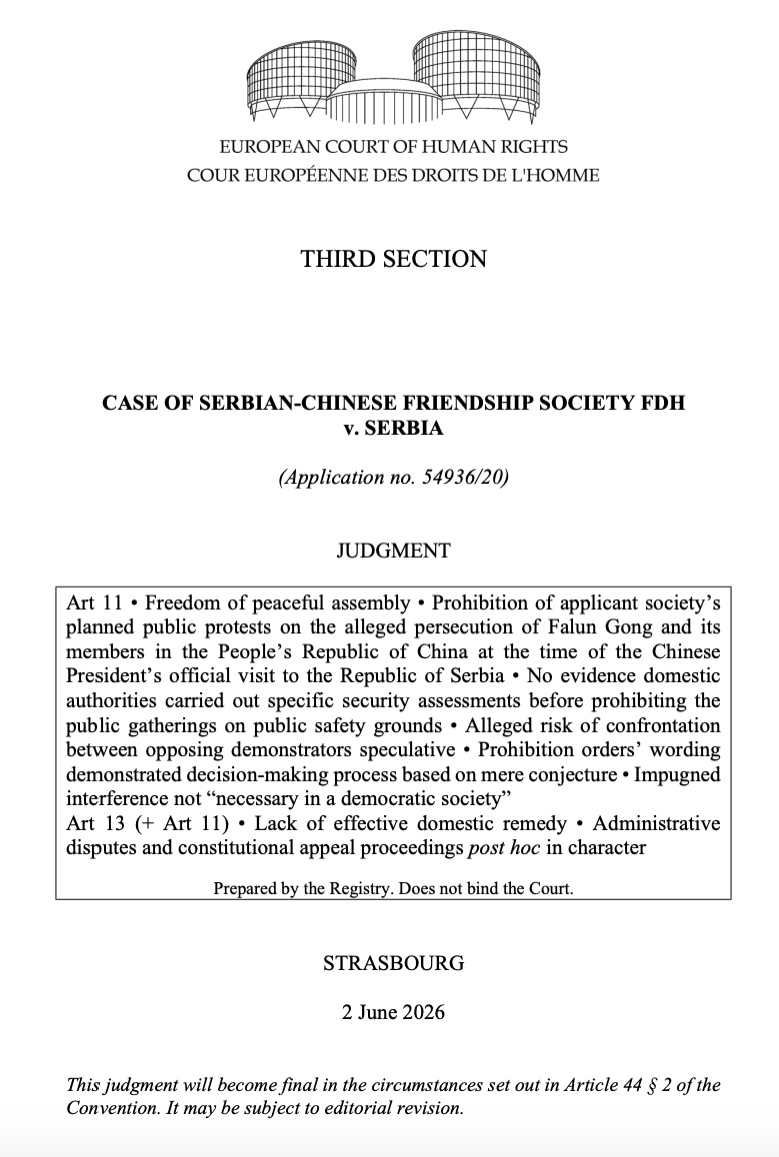 An abstract of the ruling made by the ECHR on June 2, 2026, on the case “Serbian-Chinese Friendship Society FDH v. Serbia. The court decided that Serbia had violated Article 11 and 13 of the European Convention on Human Rights. (Screenshot from the European Court of Human Rights website)
Full text of the court ruling:
https://hudoc.echr.coe.int/eng#{%22itemid%22:[%22001-250308%22]}
Below is an extract from the court ruling:
Serbian-Chinese Friendship Society FDH v. Serbia case(Application no: 54936/20)
Ruling
Article 11 – Freedom of peaceful assembly
Prohibition of applicant society’s planned public protests on the alleged persecution of Falun Gong and its members in the People’s Republic of China at the time of the Chinese President’s official visit to the Republic of Serbia
No evidence domestic authorities carried out specific security assessments before prohibiting the public gatherings on public safety grounds
Alleged risk of confrontation between opposing demonstrators speculative
Prohibition orders’ wording demonstrated decision making process based on mere conjecture
Impugned interference not “necessary in a democratic society”
Art 13 (+ Art 11) Lack of effective domestic remedy Administrative disputes and constitutional appeal proceedings post hoc in character
Spokesman for Falun Dafa Association: Every European Citizen Should Have Basic Rights
Dejan Markovic, chairman of the Serbia Falun Dafa Association, said, “This is a very important decision, although it comes after 10 years. The Serbian authorities repeated this offense more than 20 times, in many cities all over the country, at different times, by not allowing Falun Gong practitioners to execute their constitutional right, namely the right to assembly and right to have effective legal remedy.
“We hope we will not be interfered with in future activities held to raise awareness about the persecution of Falun Gong in China. These are basic rights every European citizen should have.”
To date more than 20 public gatherings announced by Falun Dafa practitioners according to the law have been banned. Since 2014 when then Chinese premier Li Keqiang visited Serbia, all protests have similarly been banned. Eight Falun Gong practitioners from many countries in the EU were illegally detained. They were released after urgent action by EU organizations. In 2024 when Chinese President Xi visited Serbia, seven local practitioners and their supporters were detained again – with the excuse that they were “a threat to society,” but again the authorities did not provide any evidence to substantiate these claims.