

(Minghui.org) C-219, a legislation that aims to strengthen sanctions against foreigners who commit corruption and transnational human rights repression, passed its third reading in the House of Commons of Canada on October 8, 2026. The next step requires it be adopted in the Senate and Royal Assent before it becomes law.
C-219 was introduced in September 2025 by James Bezan, the Conservative Shadow Secretary for Defense and a Member of Parliament (MP). It passed the second reading on October 5, 2025, and is now in the third reading.
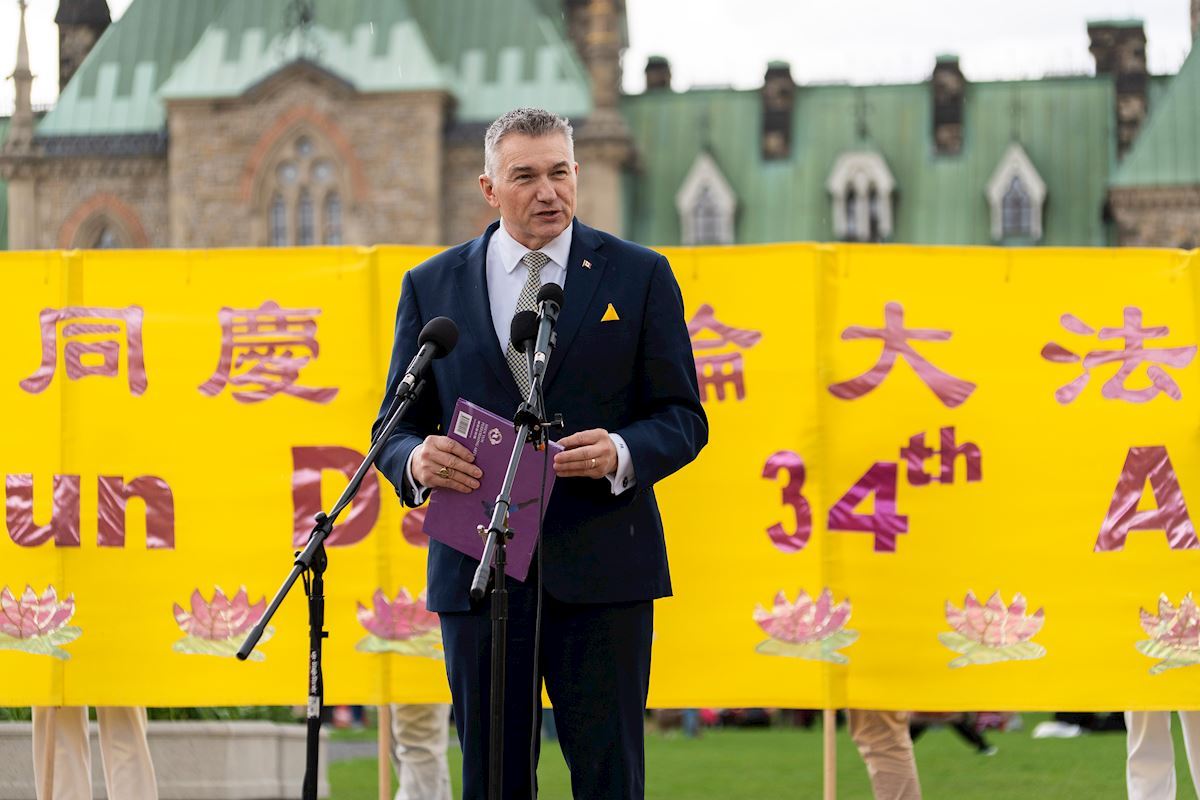 Conservative Shadow Defense Secretary and MP James Bezan (Minghui.org)
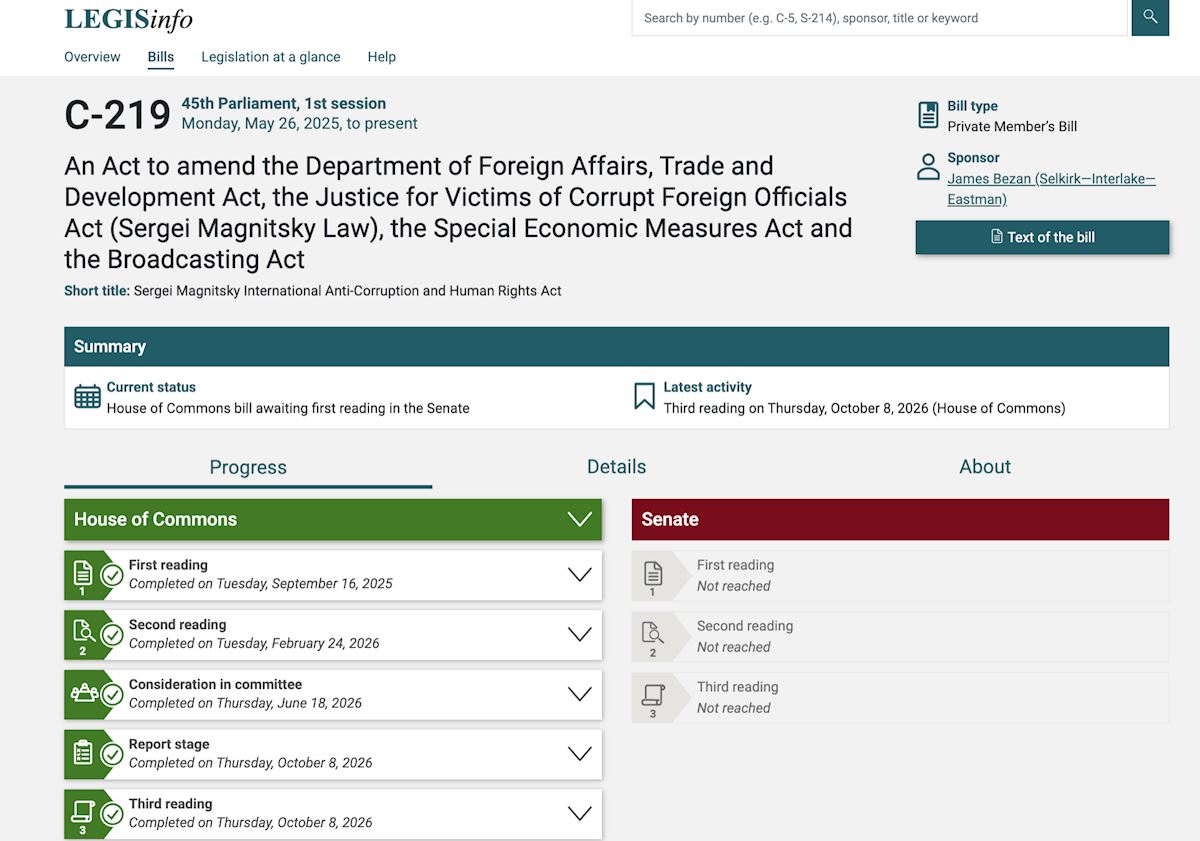 Legislation C-219 on the House of Commons website
The legislation aims to strengthen Canada’s sanctions and accountability mechanisms for foreign human rights abusers and corrupt officials. Key provisions include: explicitly combating transnational repression; revising and renaming existing sanctions laws; enhancing transparency and parliamentary oversight mechanisms; and protecting prisoners of conscience and human rights defenders.
As a key advocate for the 2017 Justice for Victims of Corrupt Foreign Officials Act (known as the Sergei Magnitsky Act), Bezan stated in a press release on October 9, “I am pleased to table my Private Member’s Bill to strengthen Canada’s sanctions regime to better align with ally countries through the imposition of economic measures and visa bans for immediate family members, change the name of SEMA, and provide a mechanism to remove broadcast licenses from sanctioned entities.”
Targeting Transnational Repression and Strengthening Sanctions
The legislation formally incorporates transnational repression into the legal sanctions system. It emphasizes that the Canadian government has the right to directly sanction foreign citizens who act on behalf of foreign governments in carrying out or participating in transnational repression, including measures such as freezing assets and banning entry.
In addition to revising the Magnitsky Act of 2017, the legislation also amends the Special Economic Measures Act, incorporates the definitions of “prisoners of conscience” and “transnational repression” into Canadian law, and sets time limits for the government to seize frozen assets; these assets can then be used to compensate those who have suffered human rights abuses and threats or who have been harmed by corruption.
The legislation amends the Justice for Victims of Corrupt Foreign Officials Act, further clarifying and expanding the criteria for identifying and punishing foreign officials who seriously violate internationally recognized human rights or engage in major corruption. It also renames the Special Economic Measures Act to the Global Sanctions and Special Economic Measures Act (Sergei Magnitsky Law No. 2), unifying Canada's legal framework in the field of international sanctions.
The third reading of the legislation strengthens the penalties under the Magnitsky Act and the Special Economic Measures Act, aligning the enforcement of sanctions between the two—a maximum fine of CAD 100,000, a maximum imprisonment of three years, or both.
Protecting Prisoners of Conscience and Human Rights Defenders
The legislation defines and clarifies the legal concept of “prisoners of conscience”—people who are detained or have their freedom restricted because of their beliefs (such as Falun Gong, Christianity, Islam, and so on) or their identity.
The legislation, through legal means, cuts off the avenues for officials who imprison or persecute prisoners of conscience and dissidents overseas to transfer assets or reside in Canada, preventing Canada from becoming a safe haven for human rights abusers.
After introducing C-219 last September, Bezan stated in an interview that the legislation was the first to explicitly define “transnational repression” in Canadian law. “This allows us to sanction foreigners who commit transnational crimes in Canada through foreign interference and intimidation,” he explained.
Legislation C-219 also allows the Canadian government to combat the Chinese Communist Party’s (CCP) surveillance and threats against Falun Gong practitioners, Hong Kong residents, Taiwanese, and other expatriate communities in recent years through illegal overseas “police stations,” embassies, consulates, and united front organizations.
“By having this bill, we would more clearly define what those prisoners of conscience and human rights defenders are and ensure that we are standing up and fighting for each and every one of them around the world,” Bezan said during the second reading.
Enhancing Transparency and Congressional Oversight Mechanisms
The implementation of legislation C-219 will also increase transparency and strengthen congressional oversight mechanisms, such as regular reporting and filing. It requires the government to notify and file with both chambers of parliament within a specified period (e.g., 15 days) for all sanctions decisions or executive orders made under the legislation. It increases the effectiveness of enforcement and evidence collection. The legislation also amends the provisions on the admissibility of evidence such as customs documents and commercial invoices so as to more effectively prosecute criminal violations of the sanctions.
Bezan stated that he hopes to establish a mechanism that allows Canadians and the expatriate community to speak out in parliamentary committees in the House of Commons and the Senate and to submit specific lists of sanctions and evidence to define which individuals should be sanctioned under the Magnitsky Act or the Special Economic Measures Act.
In 2024, Falun Gong practitioners submitted sanctions lists to 45 countries worldwide, calling for the freezing of assets and entry bans for those on the lists. In 2021, on behalf of the Falun Dafa Association, Bezan submitted a list of 150 Chinese Communist Party officials.
Canadian Professor: Both Symbolic and Substantive
Maria Cheung, an emeritus professor at the University of Manitoba, said in an interview that the passage of C-219 through its third reading in the House of Commons is a breakthrough and highly symbolic in protecting people persecuted by transnational repression. Previously, Canada had no legislation specifically addressing transnational repression.
In December 2024, the Canadian government imposed sanctions on eight senior Chinese Communist Party officials under the Special Economic Measures Act, citing reasons including the systematic persecution of Uyghurs, Tibetans, and Falun Gong practitioners.
Professor Zhang emphasized that including the Special Economic Measures Act is of substantial significance. She said that, once the legislation becomes law, the implementation of sanctions will be crucial and cited examples such as protecting non-English speaking victims and providing them with channels to report their experiences of persecution immediately.
“The bill strengthens Canada’s sanctions framework to ensure Canada is not being used as a safe haven by corrupt foreign officials and gross human rights offenders,” Bezan posted on social media on October 10. “For the first time in Canadian law we are defining prisoners of conscience and transnational repression in Canadian law to help address the growing foreign interference in our country.”
All content published on this website is copyrighted by Minghui.org. Minghui will produce compilations of its online content regularly and on special occasions.